2026-10-28
Sagging Belly Fat: How Abdominoplasty Can Help
Explains why sagging belly skin persists after weight loss or childbirth and how abdominoplasty treats fat, muscle, and skin in one surgery, plus recovery tips.
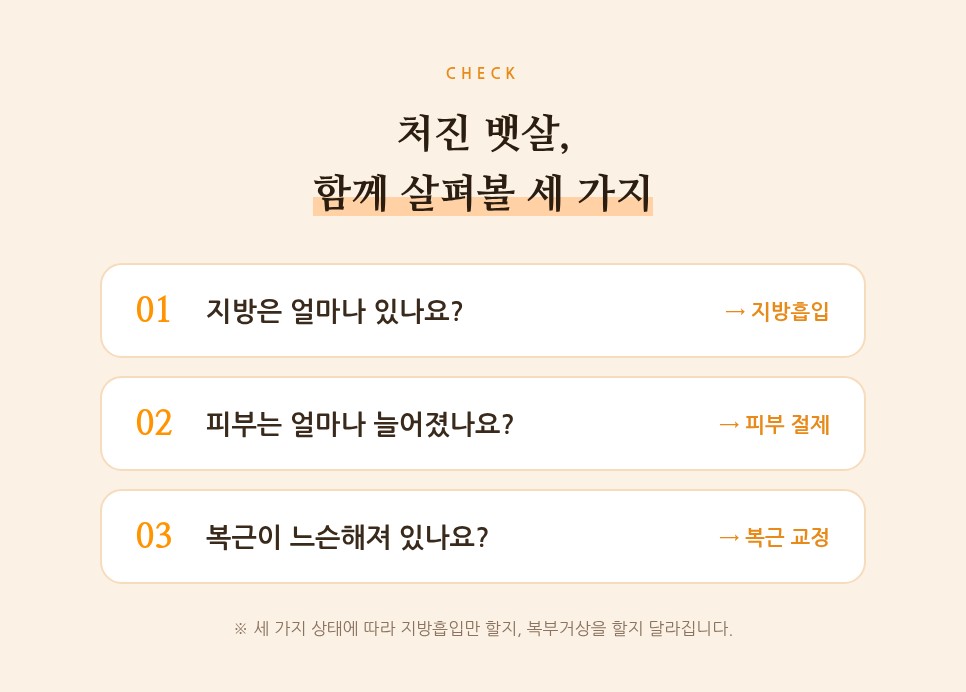
Sagging belly fat,
How abdominoplasty can help fix it
You've lost weight, so why hasn't your sagging belly fat gone away?
Hello, everyone.
I am Dr. Chang-hyun Oh, director and board-certified plastic surgeon at Tangle Plastic Surgery.

Your weight has dropped, but does the skin on your lower belly still hang and fold over?
Whether after childbirth or after a successful diet,
the concern that your belly in particular never returns to what it used to be
is something I hear very often in consultations.
Today, I'll walk you through why sagging belly fat happens
and how abdominoplasty can address it, step by step.
'Sagging Belly Fat: How Abdominoplasty Can Help' |
1. Why Doesn't Sagging Belly Fat Go Back? |
2. Abdominoplasty Addresses Three Things at Once |
3. Mini, Full, or Extended, Based on Degree of Sagging |
4. Why Deep-Layer Fat and Fascia Are Preserved |
5. Surgery Information and Recovery Care |
1. Sagging Belly Fat, Why Doesn't It Go Back? |
"Skin that has stretched once never fully returns to its pre-weight-gain state."
Just like a balloon that keeps its marks even after the air is let out,
our bodies keep the marks when we gain and then lose weight.
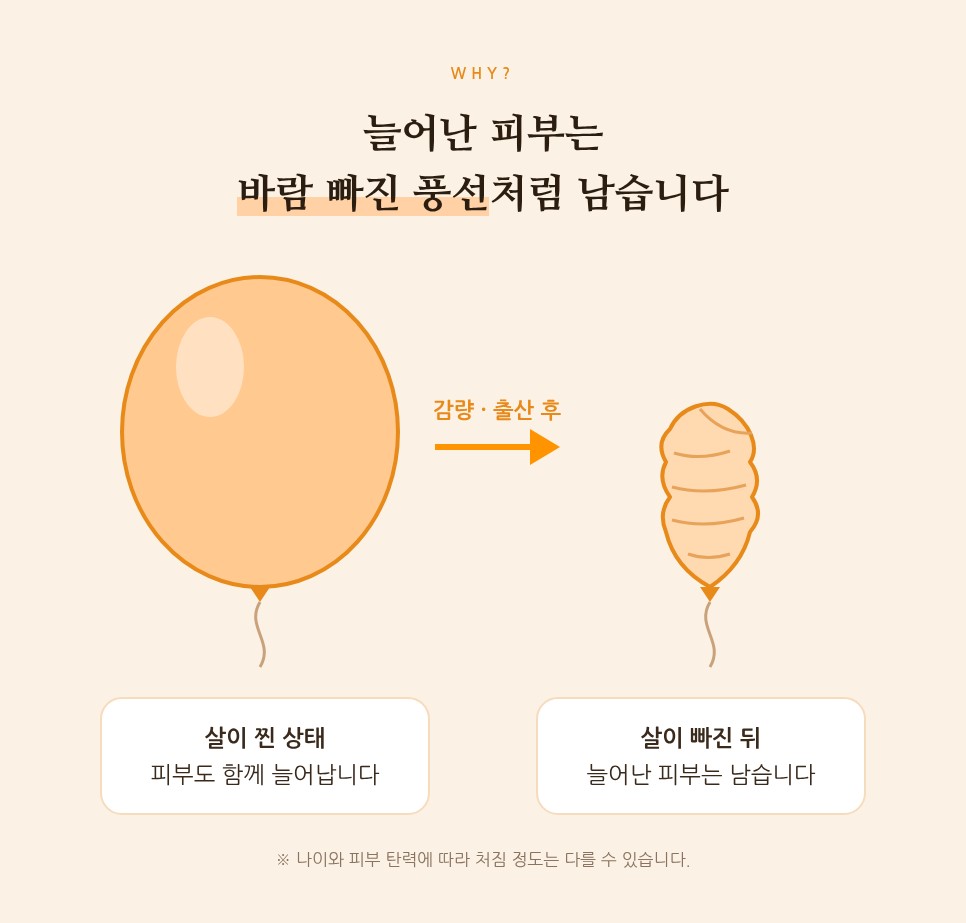
Pregnancy, childbirth, and significant weight loss each stretch the skin.
On top of that, if weight regain happens repeatedly, the sagging gets worse.
Younger people or those with good skin elasticity may experience less sagging,
but it can happen to anyone.
So what about liposuction?
If the belly fat has sagged only slightly and the skin still has good elasticity,
liposuction can produce a reasonable improvement.
However, if there is a lot of fat and skin elasticity has also declined,
liposuction alone may cause the skin to sag even more.
This is because liposuction removes fat but does not tighten
the stretched skin or the loosened tissue beneath it.
That's why I don't judge sagging belly fat by the amount of fat alone.
How much fat is there, how much has the skin stretched, and have the abdominal muscles loosened?
We need to look at all three together to choose the right approach.
2. Abdominoplasty Addresses Three Things at Once |
"We address fat, abdominal muscles, and skin in a single procedure."
Abdominoplasty (tummy tuck) involves
liposuction, tightening of loosened abdominal muscles, and removal of sagging skin
all in a single surgery.
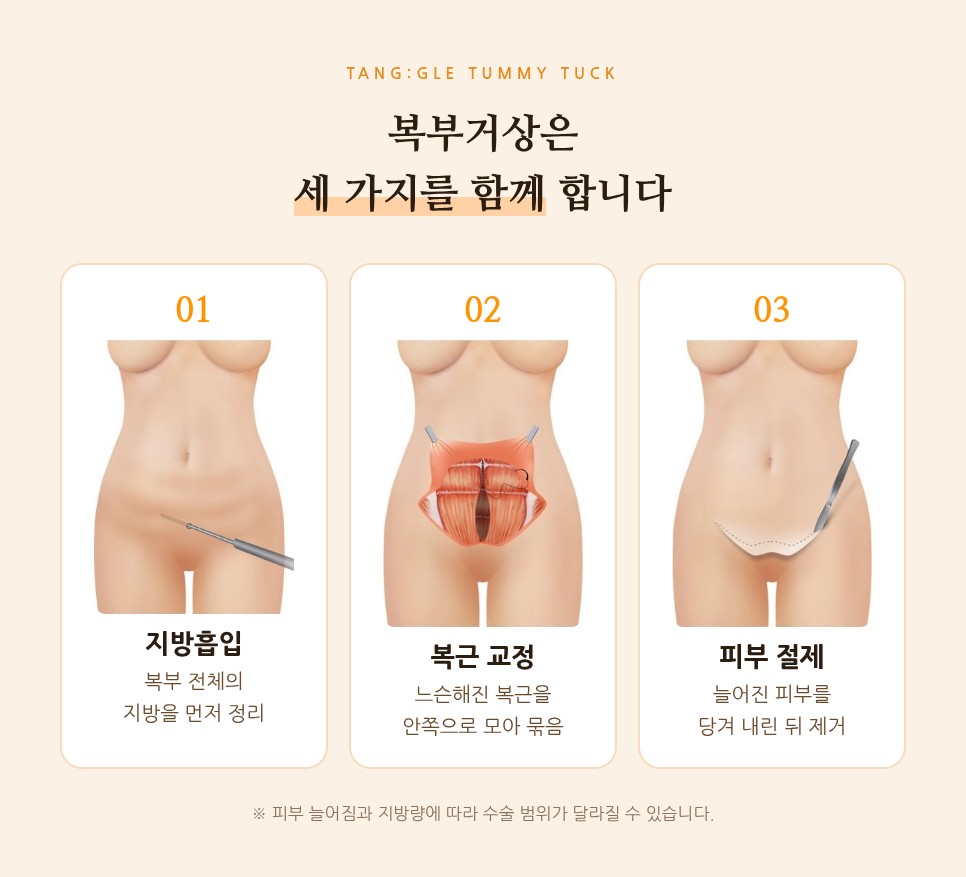
It isn't a surgery that simply pulls the skin tight; it looks at the condition of the fat, skin, and abdominal muscles together.
If the abdominal muscles separate after childbirth, the belly can look protruding even without much fat.
In such cases, during surgery, I gather the loosened rectus abdominis muscles toward the midline and suture them together.
If the abdominal muscles are not loose, I do not perform muscle tightening.
Next, I pull the remaining skin downward, remove the excess, and close the incision with reduced tension.
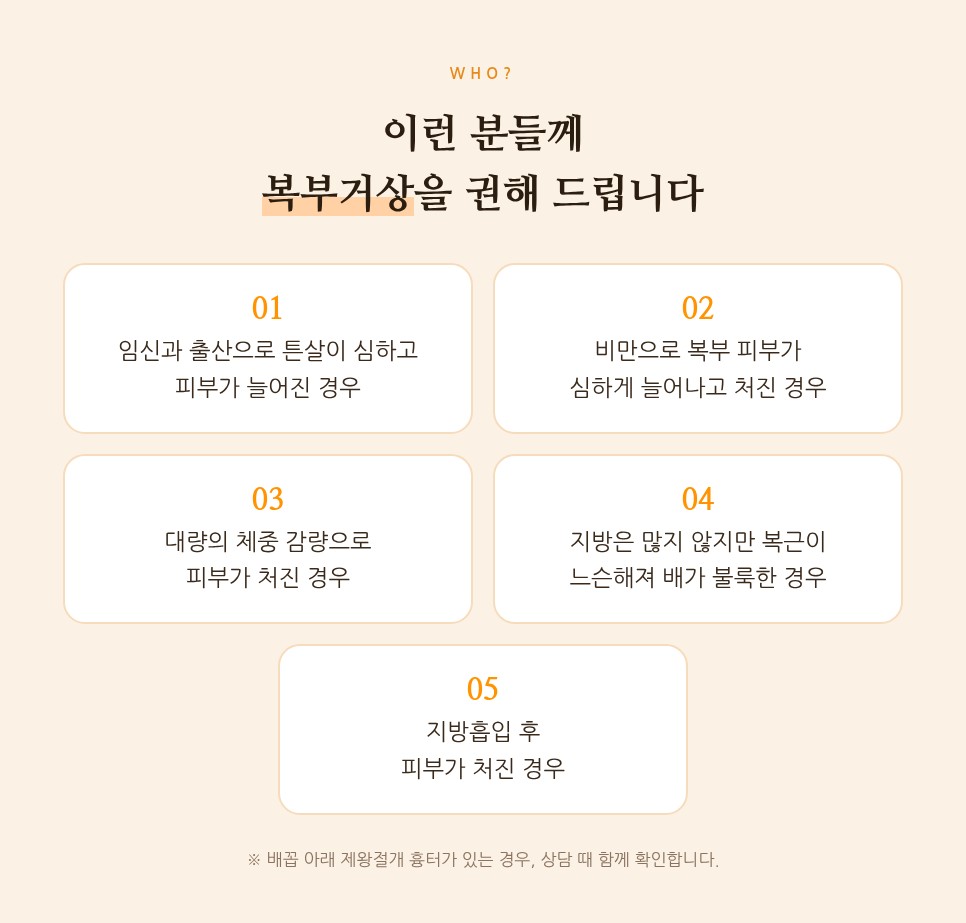
✔ Severe stretch marks and sagging skin from pregnancy and childbirth
✔ Severely stretched and sagging abdominal skin due to obesity
✔ Sagging skin after major weight loss
✔ Not much fat, but a protruding belly due to loose abdominal muscles
✔ Sagging skin after liposuction
Many people also have a cesarean scar below the navel.
I check this during consultation as well.
3. Mini · Full · Extended, Based on Degree of Sagging |
"The extent of surgery varies with the degree of sagging."
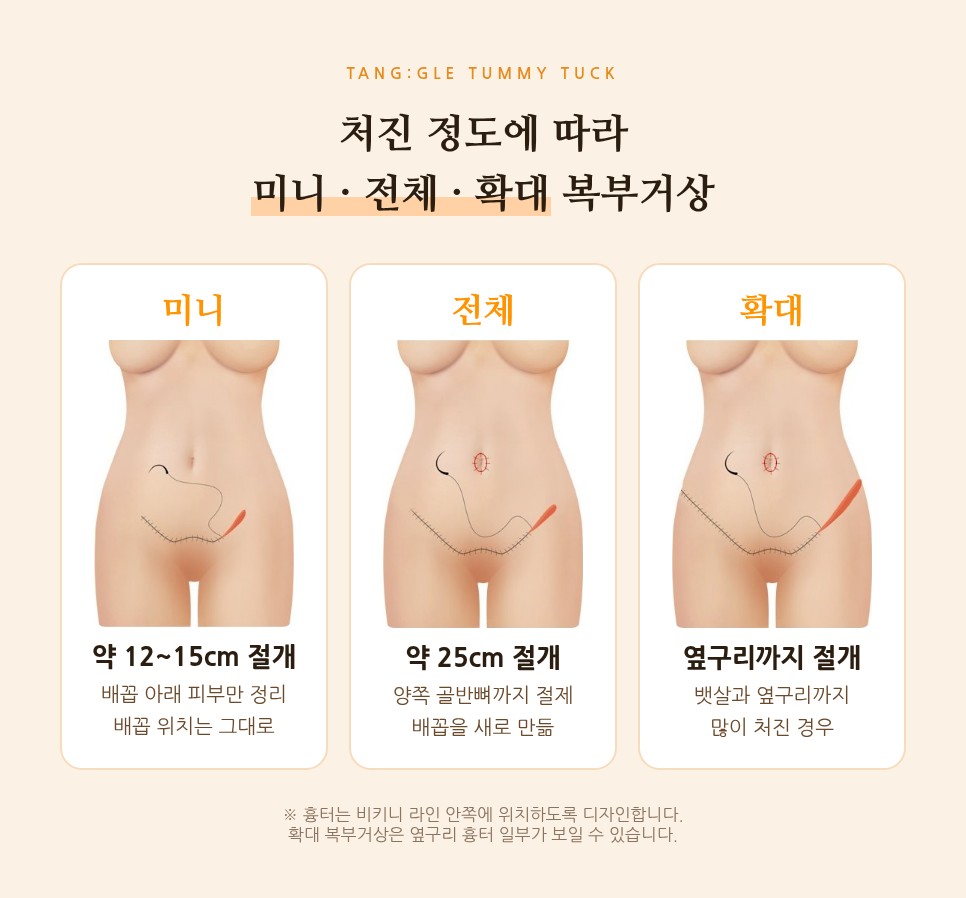
Mini abdominoplasty is for cases with fat and mild muscle laxity
and slight skin sagging.
An incision of about 12–15 cm is made just below the bikini line,
and only the skin below the navel is addressed, so the navel stays in its original position.
Full abdominoplasty is for cases with significant muscle laxity
and considerable loss of skin elasticity that causes marked belly sagging.
An incision of about 25 cm is made extending to both hip bones,
and the skin above the navel is pulled down to create a new navel.
Extended abdominoplasty is suited to cases where there is significant sagging not only in the belly but also in the flanks.
The incision extends to both flanks.
The extent of surgery is determined by the actual degree of sagging, not by the desired scar length.
The more severe the sagging, the longer the incision may need to be.
All scars are designed to be hidden inside the bikini line.
However, with extended abdominoplasty, parts of the flank scars may be visible.
During consultations, I design the incisions myself in most cases
and explain the incision location, length, and even the navel position.
I do this because I believe patients should clearly understand
what surgery will be performed and what results they can expect.
4. Why Deep-Layer Fat and Fascia Are Preserved |
"The key is to achieve results while protecting the body as much as possible."
When abdominoplasty was first introduced, the skin and fat across the entire abdomen
were lifted broadly, all the way down to just above the muscle.
As a result, the fat and fascia failed to reattach properly, leaving an empty space between them.
Seroma, the buildup of fluid in that space, was a common side effect.
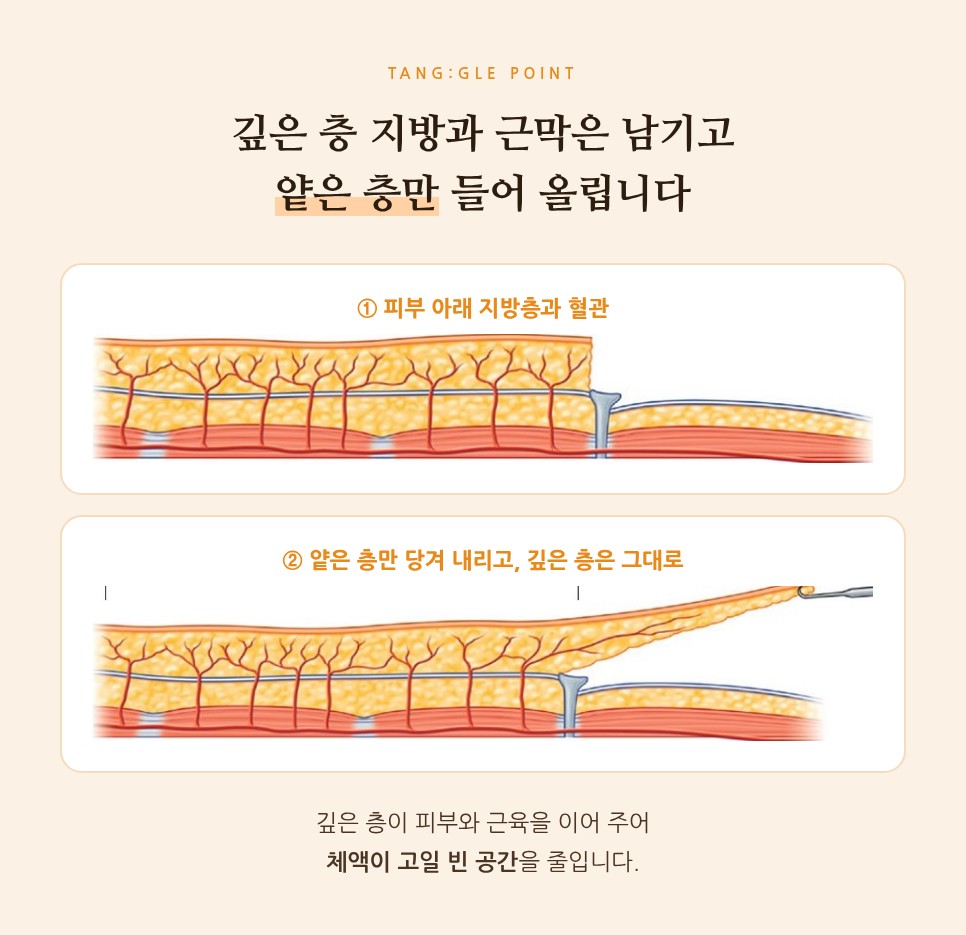
That's why I divide the fat layer into superficial and deep layers,
lifting only the superficial layer and preserving the deep fat and fascia.
The deep layer connects the skin and muscle, which reduces the space where fluid can collect.
In addition, dissection above the navel is limited
so that major blood vessels and nerves are preserved as much as possible.
This is why abdominoplasty and liposuction can be performed together.
5. Surgery Information and Recovery Care |
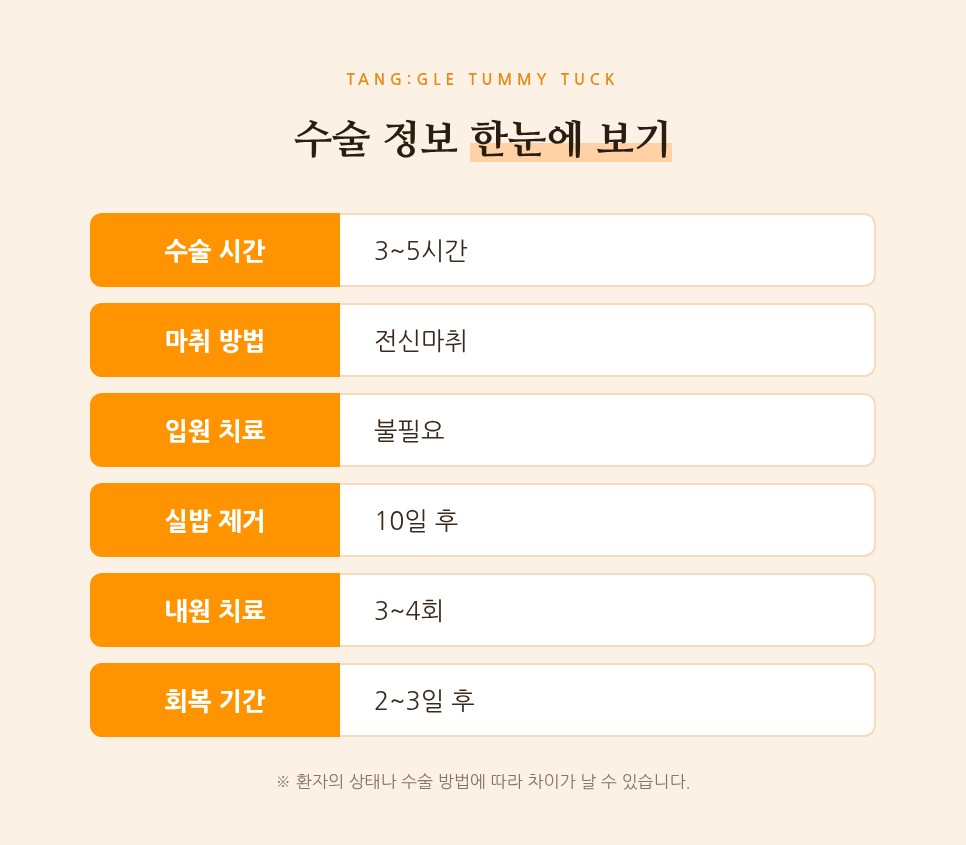
※ Details may vary depending on each patient's condition and the surgical method.
Mini abdominoplasty may be performed under local anesthesia or sedation, depending on the situation.
Pain varies from person to person, but most people feel discomfort for about 2–3 days,
after which they improve considerably.
If the abdominal muscles were tightened or a large volume of liposuction was performed, the discomfort may be a bit greater.
Swelling is most pronounced around days 7–10 and naturally subsides after about a month.
The surgical drains are removed around days 5–7.
From then on, you'll feel much more comfortable.
Compression garments are not optional; they are essential.
Wear them for about 3 months if the abdominal muscles were tightened, or about 2 months if they were not.
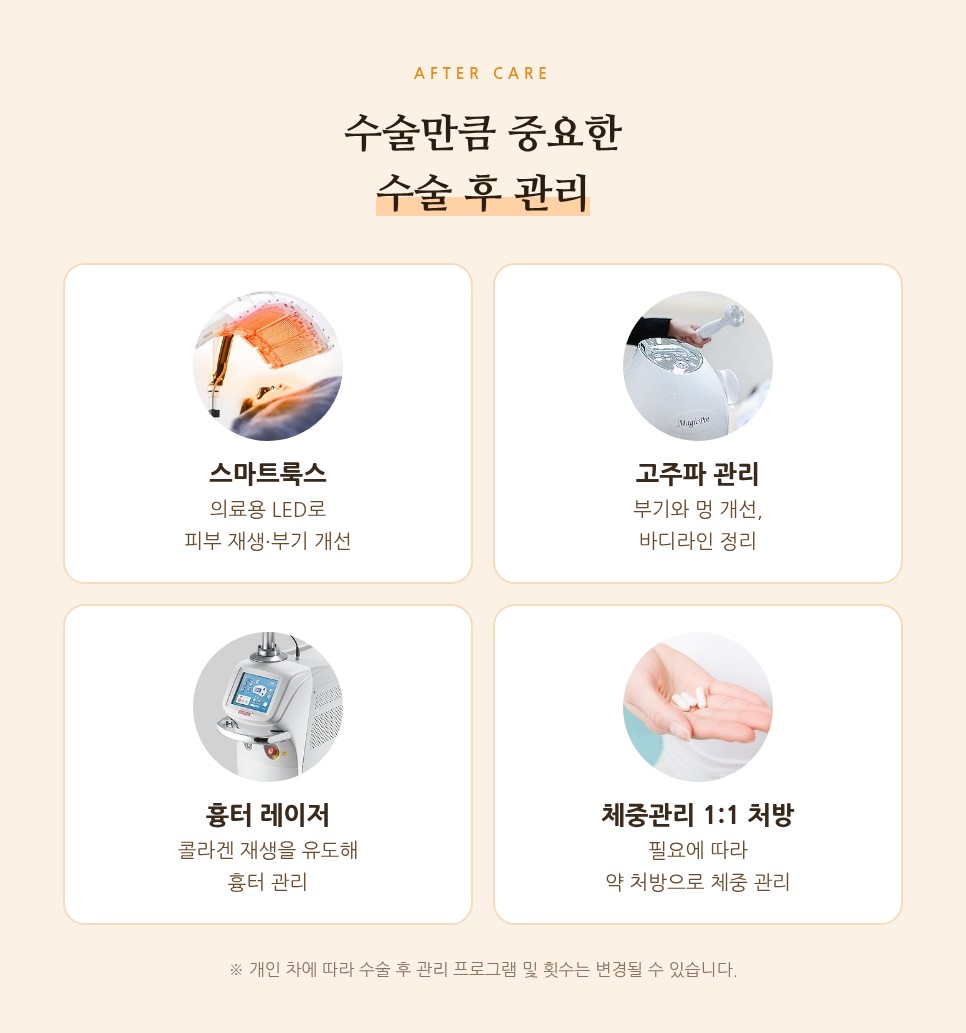
To support recovery, Tangle provides personalized post-surgery care,
including Smartlux, radiofrequency treatment, and scar laser treatment.
The more consistently scars are cared for, the less noticeable they become.
After the sutures are removed, apply scar ointment for at least 6 months,
and starting at 2 months, visit the clinic for scar laser treatments.
That said, abdominoplasty is not a procedure that leaves no scars.
Complications such as bleeding, infection, and inflammation, as well as seroma, hematoma, and decreased sensation,
will be thoroughly explained during consultation.
Today,
'Sagging Belly Fat: How Abdominoplasty Can Help',
I wrote about this topic.
Abdominoplasty is not a surgery you can describe as simply as
"I'll make you look more beautiful."
The abdomen is the center of the body, so it's not just about sagging belly fat;
the balance between the upper and lower body must also be considered.
Skin stretched after childbirth, sagging left after major weight loss,
and a protruding belly from loose abdominal muscles: even when the concern looks the same, each condition is different.
Accurately assessing the degree of sagging and performing surgery within the right scope:
I believe this is the starting point for solving sagging belly fat.
During consultations, I will fully explain the appropriate scope of surgery, the recovery process,
and important precautions.
Complications that may commonly occur after surgery, such as bleeding, infection, and inflammation, can vary in severity from person to person, so caution is needed. Scarring will remain at the incision sites, and the degree of scarring may vary by individual. Surgical results may also differ from person to person. |
<Related Posts>
https://blog.naver.com/ohtanggle/223682657998 |
https://blog.naver.com/ohtanggle/223713752734 |
https://blog.naver.com/ohtanggle/223684924585 |
Tangle Plastic Surgery Clinic Information
Main Phone: 02-542-8427
Weekdays 10:00 – 19:00
Saturday 10:00 – 17:00
(Closed on Sundays and public holidays)
- Directions -
842 Nonhyeon-ro, Gangnam-gu, Seoul
Apgujeong Building, 7th Floor
3-minute walk from Exit 3 of Apgujeong Station (Line 3)
Frequently Asked Questions
Why does my belly still sag even after losing weight?
Skin that has been stretched once never fully returns to its pre-weight-gain state. Pregnancy, childbirth, and significant weight loss all stretch the skin, and repeated weight regain can cause the sagging to progress further.
Can liposuction alone fix sagging belly fat?
It depends on the case. If the skin still has elasticity and the sagging is mild, liposuction can produce some improvement. However, if there is a lot of fat and skin elasticity has also declined, liposuction alone may cause the skin to sag even more.
When should abdominoplasty be considered?
It may be considered for cases such as skin that has stretched after pregnancy and childbirth, or skin that has sagged after major weight loss. It can also apply when the belly protrudes due to loose abdominal muscles, even without a lot of fat.
What's the difference between mini, full, and extended abdominoplasty?
The procedure is divided into mini, full, and extended abdominoplasty depending on the degree of sagging. Mini abdominoplasty addresses only the skin below the navel, so the navel stays in place. Full abdominoplasty creates a new navel. Extended abdominoplasty involves incisions that extend to both flanks.
How long do I need to wear a compression garment after abdominoplasty?
If the abdominal muscles were tightened, you should wear one for about 3 months; if not, for about 2 months. Compression garments are essential, not optional. Swelling peaks around days 7–10 and naturally subsides after about a month.
Will abdominoplasty leave scars?
Yes, scars will remain at the incision sites. The scars are designed to be hidden inside the bikini line, but with extended abdominoplasty, parts of the flank scars may be visible. Here's how to manage them: after the sutures are removed, apply scar ointment for at least 6 months, and begin scar laser treatments from 2 months onward.